Best Scenic Transit Hotels United States: Ultimate Editorial Guide
Navigating the spatial friction, federal aviation zoning mandates, acoustic engineering challenges, and multi-modal distribution systems governing exceptional layover accommodations within major North American transportation hubs demands rigorous structural analysis. Traditional travel media frequently mischaracterizes properties situated adjacent to or within major U.S. aviation gateways, reducing them to generic accommodations chosen strictly for transit proximity. However, terminal-integrated architectural masterpieces, airfield-adjacent properties featuring unobstructed runway vistas, and mountain-view transit lodges operate under severe spatial, regulatory, and environmental constraints. Federal building height restrictions, sound-attenuation performance standards, strict airport authority lease agreements, and dynamic micro-stay inventory distribution channels dictate whether a scenic short-stay asset functions smoothly or encounters systemic failure.
Achieving long-term commercial resilience and operational stability across panorama-driven transit hospitality assets requires managing complex operational trade-offs. Facility planners and modern corporate travel managers must navigate the volatility of flight routing schedules, municipal zoning shifts, and the high maintenance liabilities associated with triple-glazed acoustic curtain walls exposed to jet blast and varied weather conditions. Consequently, these operational choices tie overall guest satisfaction and financial viability directly to precise architectural engineering, real-time aviation data synchronization, and rigorous environmental controls. Furthermore, analyzing the structural design and operational mechanics of the best scenic transit hotels united states illuminates wider developments in contemporary airport real estate economics and intermodal infrastructure planning. This analysis explores the core operational workflows and structural principles required to master landscape-integrated transit assets across diverse regional U.S. aviation corridors.
Understanding best scenic transit hotels united states

Evaluating specialized panorama-driven transient hospitality frameworks across North American transport jurisdictions involves complex classification terminology. Observers frequently conflate standard downtown luxury hotel metrics with airport-adjacent asset evaluations governed under strict Federal Aviation Administration (FAA) surface limitation guidelines and local zoning ordinances. However, this assumption obscures structural variances in soundproofing requirements, airspace clearance limits, and hourly inventory distribution models. Micro-environments range from mid-century architectural preservation landmarks overlooking active runways to high-altitude resort-style gateway properties framed by dramatic mountain ranges.
Developing or managing an elite scenic hospitality framework across a high-traffic American transportation hub requires navigating strict building height limitations, environmental impact reviews, and airport authority lease agreements. Perimeter access restrictions and complex municipal shuttle corridors add further complexity. Conversely, operating a terminal-integrated property with panoramic airfield views involves heavy capital lease obligations, specialized acoustic glazing to block turbine noise, and variable check-in surges tied directly to major airline banking waves. Therefore, real estate evaluators and corporate risk controllers must inspect micro-level architectural integration and inventory distribution channels closely.
True expertise in evaluating the best scenic transit hotels united states requires balancing quantitative inventory metrics against qualitative environmental and visual asset measures. Unlike continental commercial hotels relying on standard urban vistas, top-tier scenic transit properties exist within dynamic, 24-hour operational loops defined by shifting daylight, lighting glare management, and active airfield kinematics. Experienced asset managers look past standard daily occupancy percentages. Instead, they assess flight arrival volatility, hourly turnover velocity, structural window thermal performance, and the actual contractual scope of multi-slot booking windows relative to premium scenic view premiums. Ultimately, failing to master these operational realities leads directly to severe inventory leakage, guest displacement during mass flight cancellations, acoustic compliance failures, and unrecoverable capital exposure.
Deep Contextual Background
The historical evolution of scenic and terminal-integrated airport hospitality in the United States traces back to the golden age of commercial aviation during the mid-twentieth century, marked by iconic terminal designs like Eero Saarinen’s 1962 flight center at New York’s JFK Airport. Post-war commercial aviation expansion and the establishment of hub-and-spoke routing models by legacy U.S. carriers shaped key national gateways, where early airport hotels prioritized functional convenience over environmental aesthetics or architectural distinction. During earlier eras, transit properties relied on rudimentary masonry construction and basic single-pane glass, offering minimal acoustic isolation and limited line-of-sight visual engagement with the surrounding airfield or regional landscape.
Following the late-twentieth-century deregulation of the airline industry and the subsequent introduction of computerized reservation and yield management systems, airport real estate underwent a structural shift. Developers began recognizing the commercial value of pairing high-capacity aviation infrastructure with striking architectural design and expansive regional views, leveraging advanced acoustic engineering to neutralize engine noise. In recent decades, the acceleration of airport city (“aerotropolis”) development and traveler demand for experiential enrichment have driven an unprecedented need for resilient, design-forward hospitality frameworks. Today, contemporary property managers rely on advanced predictive analytics, smart glazing technologies, and synchronized application programming interfaces to oversee high-turnover portfolios safely across changing weather patterns and flight schedules.
Conceptual Frameworks and Mental Models
Successfully administering panorama-driven short-stay properties across major American aviation hubs while mitigating structural hospitality hazards requires deploying rigorous analytical models. These models balance environmental aesthetics and flight schedule volatility against room turnover logistics and acoustic performance.
-
The Acoustic-Visual Equilibrium Index measures the statistical ratio of sound attenuation performance to exterior window transparency and panoramic field-of-view breadth within a high-decibel airfield environment.
-
The Terminal Spatial Friction Matrix evaluates how automated rail links, security screening checkpoints, and multi-modal roadway congestion impact guest arrival predictability and scenic room utilization.
-
The Flight Delay Volatility Gradient analyzes the strategic trade-off between holding premium view room inventory for delayed inbound passengers versus releasing space to walk-in travel traffic during regional weather disruptions.
Key Categories and Variations
The landscape of architectural typologies and service models defining scenic transit accommodation management comprises several distinct structural variations across North American aviation jurisdictions.
| Scenic Transit Hotel Category | Primary Geographic Focus | Typical Structural & Operational Features | Strategic Trade-off |
| Historic Architectural Restoration Hubs | Major Eastern Seaboard Gateways (e.g., JFK) | Mid-century modern preservation, direct runway viewing decks, heavy historic structural integration | Exceptional branding and visual drama; extreme maintenance costs for legacy structures |
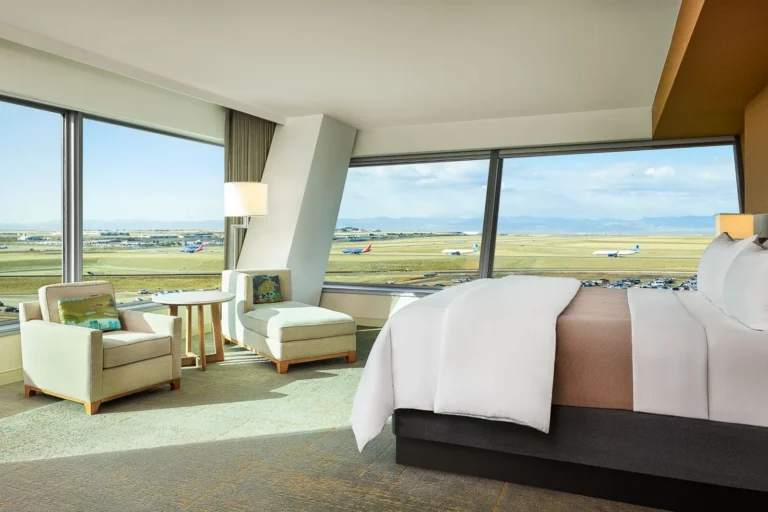
| Mountain-Vista Gateway Resorts | Intermountain West Hubs (e.g., COS, DEN) | Alpine architectural lines, triple-pane acoustic glass framing snow-capped peaks, integrated transit centers | Stunning natural backdrops; high seasonal weather vulnerability affecting local access |
| Terminal-Integrated Skyline Towers | Major Midwest and Western Hubs (e.g., DEN) | Direct pedestrian bridge connection to Jeppesen Terminal, LEED Platinum sustainability engineering, 360-degree plains views | Unmatched terminal convenience; massive capital expenditure and complex lease terms |
| Coastal Aviation & Estuary Lodges | Pacific Northwest and Coastal Gateways (e.g., SEA) | Waterfront or marine horizon sightlines, marine-grade corrosion-resistant exterior finishes | Unique coastal scenery; heavy exposure to moisture and saltwater building degradation |
| Desert Horizon Perimeter Properties | Southwest Aviation Hubs (e.g., PHX, LAS) | Low-profile desert architecture, courtyard layouts emphasizing expansive sunset and mountain horizons | Striking geological backdrops; intense thermal management and HVAC maintenance demands |
| Intermodal Rail-Air Scenic Nodes | Northeast Corridor Multimodal Hubs | Glass-walled atriums overlooking both train tracks and tarmac, rapid self-service kiosks | High multimodal connectivity; intense operational competition from urban city centers |
| Corporate Aviation Executive Lodges | Private and Municipal Mixed-Use Airfields | Private ramp views, hangar-adjacent positioning, executive boardrooms with tarmac panoramas | Tailored for corporate aviation; narrow target demographic and lower volume |
Selecting an appropriate operational model requires aligning terminal architecture with passenger demographic expectations. For properties situated within historic architectural footprints, prioritizing customized acoustic retrofitting preserves visual heritage without sacrificing sleep quality.
Detailed Real-World Scenarios
The Mid-Century Runway Panorama Optimization
Following a major modernization project, a historic terminal-adjacent hotel in the Northeast implements triple-glazed acoustic curtain walls facing the primary departure runway. The property’s operational management team coordinates with air traffic control data feeds to offer real-time aircraft identification displays in guest rooms, transforming potential noise friction into an immersive visual amenity.
The Mountain Gateway Thermal and Glare Management Challenge
Facing intense high-altitude solar radiation and dramatic diurnal temperature shifts, an intermountain aviation resort manages its expansive glass facades using automated exterior louvers and smart tinting glass. This system maintains unobstructed views of surrounding peaks while reducing interior cooling loads during peak afternoon sun exposure.
The Terminal-Integrated Bridge Crowd Surge
A flagship hotel connected directly to a major western hub’s central terminal experiences a sudden influx of passengers displaced by an airspace closure. The property’s automated guest management system activates pre-scripted queuing protocols along its dedicated pedestrian bridge, balancing walk-in visitor flow with confirmed reservation holders.
The Coastal Corrosion and Window Maintenance Project
A scenic transit lodge situated near a marine aviation corridor executes a comprehensive exterior maintenance cycle. Technicians replace specialized window seals and apply marine-grade protective coatings to aluminum framing members, preventing salt-air oxidation from compromising the clarity of ocean horizon sightlines.
Planning, Cost, and Resource Dynamics
The economic viability and risk mitigation budgeting of elite scenic transit accommodation facilities depend heavily on specialized architectural maintenance, custom glazing insurance, and high-turnover labor outlays.
-
Specialized Acoustic Maintenance Outlays: Preserving triple-pane acoustic integrity and dynamic glass seals across extreme weather cycles requires continuous capital expenditure compared to standard suburban hotel upkeep.
-
Design-Driven Premium Yield Management: Marketing unobstructed mountain or runway vistas demands sophisticated dynamic pricing engines that balance seasonal tourist demand with erratic airline delay surges.
-
Opportunity Costs: Failing to account for rigid architectural load limits or strict airport authority height caps can restrict expansion and erode operating margins.
| Cost Dimension | Standard Urban Hotel | Traditional Airport Hotel | Advanced Scenic Transit Lodge |
| Building Envelope Upkeep | Standard masonry and dual-pane glass maintenance | Routine commercial facade cleaning | Specialized triple-pane acoustic glass and automated shading system servicing |
| Acoustic Mitigation Investment | Minimal soundproofing requirements | Moderate perimeter caulking | Heavy investment in structural damping, floating floors, and laminated glass |
| Technology Underwriting | Standard property management system | Multi-channel booking engine | Real-time flight API integration paired with view-specific room allocation software |
Tools, Strategies, and Support Systems
Executing successful operational management across scenic transit hospitality properties requires integrating advanced digital planning, monitoring, and structural maintenance tools.
-
Real-Time Flight Tracking APIs: Live aviation feeds provide precise data on flight delays and runway utilization, feeding digital concierge screens that highlight active aircraft movements.
-
View-Allocation Property Management Engines: Specialized reservation software maps exact room sightlines, allowing guests to select specific runway, mountain, or skyline orientations.
-
Automated Building Envelope Diagnostics: Integrated sensors monitor thermal performance, seal integrity, and acoustic dampening across expansive glass facades.
-
Smart Shading and Climate Control Systems: Automated motorized blinds respond to solar angles to preserve interior comfort and panoramic clarity without manual intervention.
-
Secure Digital Payment Gateways: Instant transaction processors support multi-currency billing and corporate accounts for high-end transient travelers.
-
Encrypted Access Control Systems: Smartphone-enabled digital room keys streamline high-velocity check-in workflows for time-sensitive guests.
Risk Landscape and Failure Modes
Operating high-velocity scenic transit properties introduces severe operational vulnerabilities that require comprehensive risk mitigation.
-
Acoustic Envelope Degradation: Failure of specialized window seals can allow exterior aircraft noise to penetrate guest rooms, leading to severe dissatisfaction and brand erosion.
-
Severe Weather Impact on Scenic Assets: High winds, heavy snowfall, or intense solar glare can obscure panoramic vistas, negating a primary value proposition and triggering compensation demands.
-
Integration Failures with Aviation Feeds: Loss of real-time flight status data can desynchronize operational awareness, disrupting targeted view-based room assignments.
-
High Glazing Maintenance Costs: Accelerated environmental wear on expansive glass structures requires costly specialized cleaning and structural engineering oversight.
-
Security Perimeter Compliance Violations: Mismanagement of viewing terraces or pedestrian bridges can result in unauthorized breaches of airport security boundaries.
Governance, Maintenance, and Long-Term Adaptation
Maintaining elite standards across panorama-driven transit property portfolios requires rigorous internal auditing, seasonal envelope inspections, and disciplined scheduling.
-
Pre-Season Envelope and Glazing Audits: Comprehensive inspections of acoustic seals, motorized shading mechanisms, and structural glass integrity occur prior to peak travel seasons.
-
Monthly Decibel and Visual Clarity Tracking: Detailed analysis of interior noise levels and exterior window cleanliness takes place continuously.
-
The Layered Scenic Transit Resilience Checklist:
-
Acoustic Seal Verification: Test window damping performance against standardized decibel thresholds to ensure uninterrupted quiet.
-
Flight Data Feed Diagnostics: Confirm API connections with live aviation tracking servers for real-time guest display synchronization.
-
Climate and Shading System Calibration: Calibrate automated blinds and smart glass tinting parameters for optimal glare reduction.
-
Airport Authority Compliance Review: Audit security clearances, viewing deck access logs, and lease covenants against federal mandates.
-
Measurement, Tracking, and Evaluation
-
Leading Indicators: Low interior ambient decibel readings and high scores on view-specific guest satisfaction indices serve as early operational signals.
-
Lagging Indicators: Total monthly window maintenance expenditure and repeat booking rates among business travelers measure overall asset success.
-
Documentation Standards: Maintaining an exhaustive digital archive tracks acoustic test results, glazing maintenance logs, and seasonal yield variances.
-
Benchmarking Analysis: Regularly comparing scenic room occupancy velocity against competing terminal properties ensures ongoing market optimization.
Common Misconceptions and Oversimplifications
-
“All airport hotels offer similar visual experiences and noise levels.” True operations evaluated when analyzing the best scenic transit hotels united states require advanced acoustic engineering and intentional architectural framing of natural or aviation vistas.
-
“Floor-to-ceiling glass makes soundproofing impossible near active runways.” Modern laminated and triple-pane acoustic glazing successfully reduces jet engine noise below library-quiet interior thresholds.
-
“Scenic transit properties rely exclusively on leisure travelers seeking sightseeing.” High-end scenic transit lodges capture substantial corporate and executive volume seeking inspiring environments during layovers.
-
“Automated climate systems eliminate the need for manual facade inspections.” Complex smart-shading networks require rigorous scheduled maintenance to prevent mechanical failure under extreme weather conditions.
-
“Airport authorities discourage hotels from providing direct airfield views.” Many modern master-planned aviation hubs explicitly integrate viewing platforms and architectural panoramas into terminal hospitality assets.
-
“Property management software designed for standard downtown hotels works seamlessly for scenic transit lodges.” Dedicated view-allocation and hourly inventory algorithms are essential to manage premium sightline pricing accurately.
Ethical, Practical, and Contextual Considerations
The operation of elite scenic transit accommodation assets across the United States carries profound responsibilities regarding passenger well-being, structural safety, and environmental stewardship. Property managers must ensure that guest management protocols prioritize safety, accessibility, and transparent pricing during stressful travel disruptions. Furthermore, coordinating architectural design with airport authorities ensures that public safety and secure airspace perimeters take absolute precedence over commercial view optimization.
Conclusion
The architectural engineering, algorithmic management, and operational logistics of premier scenic transit accommodation properties represent a sophisticated synthesis. When property operators and travelers master the complexities governing the best scenic transit hotels united states, structured administrative methodologies achieve true long-term resilience. Success in this specialized sector requires balancing expansive natural or aviation vistas with uncompromising acoustic isolation and robust data integration. Through patience and editorial rigor, stakeholders can protect capital investments and guarantee enduring service quality across dynamic American transit landscapes.